

Writing a Novel in NovelCrafter
Part 2: Defining Genre, Creating More Frameworks for Worldbuilding
One of my current NovelCrafter projects is a long-ish fantasy novel. The target word-count is 80,000 - 100,000 words, but writing a good story is more important than making it a specific length is.
Back in Part 1 I selected a plot outline template of about 40 chapters, created the structure of acts and chapters in NovelCrafter, and then put a detailed outline of that story structure in a new Codex entry set up in a custom Codex category called Framework.
In this part, I want to add several more Codex entries to the Framework category. If you've read my article about setting up a Customizable Genre Dev Editor Prompt, you'll already know the practical steps to do this. Those four special Codex entries I explain in that linked article will enable a Developmental Editor prompt to work and now I can define my Genre, Subgenre, and Intended Audience. I can also add some details about Subgenre Considerations.
Once I fill in the descriptions in those Codex entries, I'll be able to use the Customizable Genre Dev Editor prompt tuned to my specific novel's subgenre to begin some limited worldbuilding, but first, the novel project needs some more frameworks added to the Codex to accommodate the products of that worldbuilding activity.
If you plan to follow along, this part of the process relies heavily on tasks completed in Part 1 and in the Customizable genre Dev Editor prompt article, so please ensure those tasks are done before proceeding.
A Reminder About AI-Assisted Writing
Most likely, everyone who has discovered this article series has come to realize that Large Language Models, while incredible, are far from capable of writing great fiction... For now, at least. That means the human author's judgement and experience and understanding of the writing project, and the expectations of the audience familiar with the genre and subgenre are more superior to those of the AI. So the job I try to focus on is: guiding the AI assistants to good choices and away from undesirable results.
Defining The Genre in Detail
It took a few tries to get my genre defined and to wrinkle out some issues in these four Codex entries, but it might be useful for some people to see a few of the details before I move on to the more straightforward Codex entries and some worldbuilding.
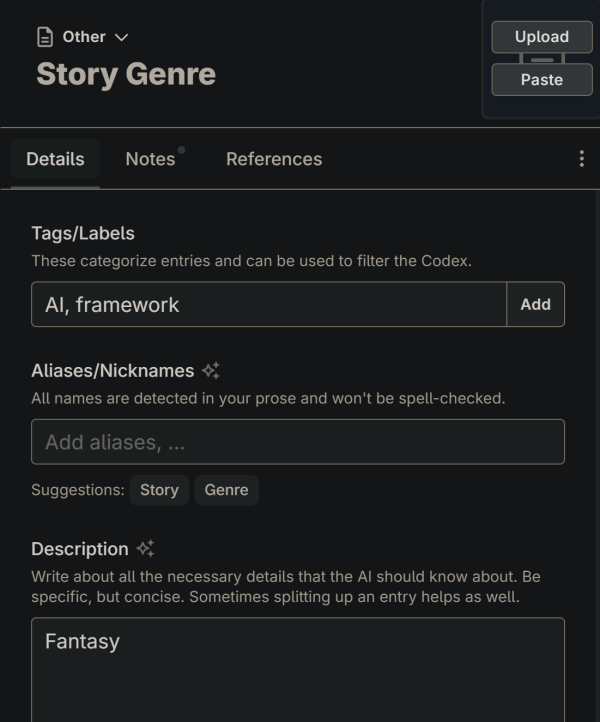
I've decided on the Fantasy genre already, so filling in the Story Genre Codex entry was quick.
The subgenre I settled on is a little more complex. It also contains the seed of an issue I'll have to deal with later. See if you can spot it:
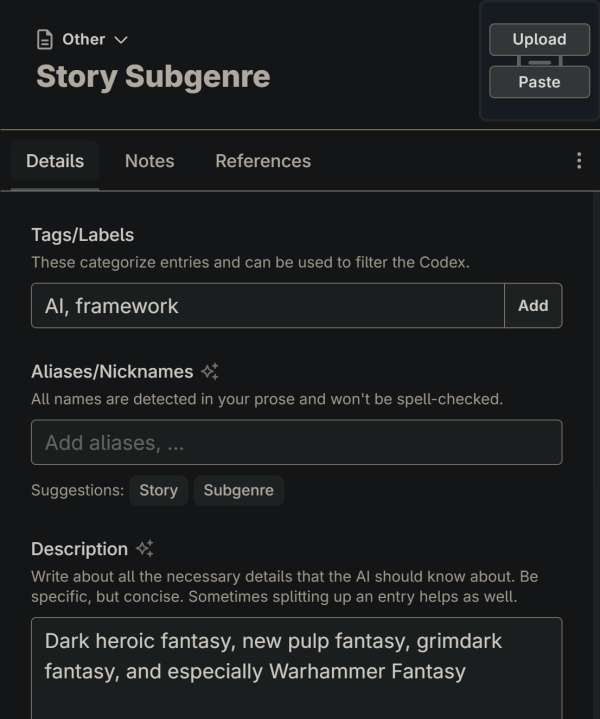
The AI Dev Editor prompt was happily able to figure out a good intersection for those closely related fantasy fiction subgenres. Unfortunately, even though I stated in my Subgenre Considerations Codex entry that this story is designed to appeal to a similar audience, yet in no way to risk violating the intellectual property of Games Workshop or their Black Library publishing imprint, Claude's Sonnet and Opus LLMs both told me they couldn't help me work on the standard developmental editing tasks I asked them to.
If I were writing for a big brand (especially one with a reputation for jealously guarding their IP), I'd have made some different statements in the Subgenre Considerations entry, such as claiming I have every permission to work with their branded content.
So I kept the Warhammer Fantasy part of the subgenre and handled those objections in the Subgenre Considerations by detailing briefly what aspects of Warhammer Fantasy fiction I want to avoid, keeping a similar flavor, but avoiding their characters, locations, lore, etc.
You can also see from the screenshot below I also handled a different issue: some of the LLMs occasionally think fantasy genre races are the same thing as human ethnicities and object to plotting conflicts between and even among them.

It's probably important to add a line in any Considerations entry reminding the LLMs yours is a work of complete fiction!
"Important: In this fantasy fiction subgenre..."
These and other things will come up with LLMs when we use them to tackle fictional events they weren't trained to anticipate. Sometimes we can switch to a different model for certain bits (as with NSFW content), and other times, the Considerations entry can help.
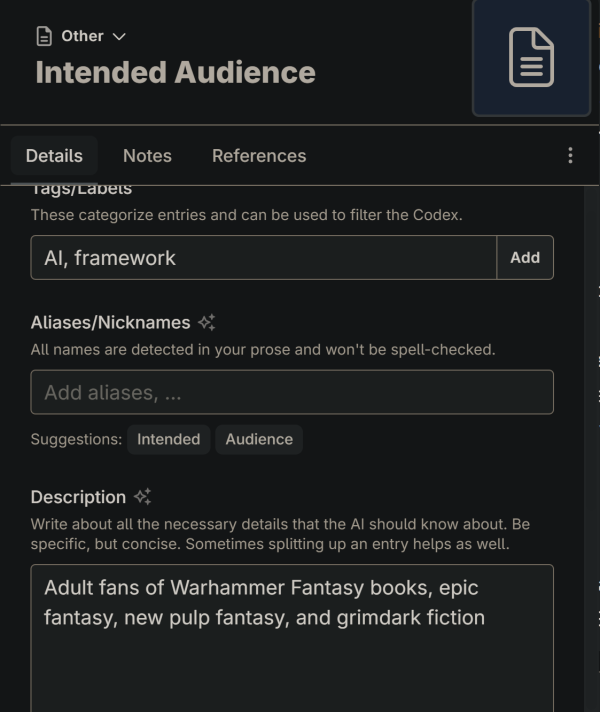
My Considerations entry is about 500-600 words for this project. By comparison, the Intended Audience entry was quick and easy to complete:
Creating More Codex Frameworks - For AI, By AI
My next step was to prepare a series fo framework templates as Codex entries before asking the Dev Editor prompt to help with worldbuilding. I made the character templates first.
Some AI models that seem too logical and uncreative to produce good prose are still useful to fiction authors. Once I completed the four codex entries above that enable the Customizable Dev Editor to work, I used that prompt with GPT4 to help design frameworks for various Codex entry frameworks I wanted to make. The point of the frameworks is that they provide a consistent way for the various LLMs to absorb things and they act as a set of guidelines for LLMs I use to generate different Codex entries, like characters, factions, etc.
I asked the Dev Editor AI using GPT-4 to make the first of a set of three character templates. These are designed to be joined together for each character. I'll write more about how I use these in the Worldbuilding part(s) of this series.
Here is the prompt I started with. I added the template outputs lower down in this article:
Using your expertise in writing dark fantasy fiction about the setting of this novel, help me by creating an ideal and thorough complete framework for consistently describing characters to Large Language Model writing assistants. There will eventually be a total of three character frameworks designed to work together as one unit to describe and define each character for use in the novel.
This one will be the main, general character template framework. There will also be two other supplementary specialized template frameworks designed later: one for elaborate description of character appearance, and one for elaborate description of character speech and communication style.
Please design only the general character template framework now. Be as detailed as necessary to give Large Language Models the best chance at consistently and fully understanding the character described in the framework.
When that was finished, I asked the LLM in the same chat, one at a time, for the other two main character templates:
Great. Now, bearing the general template in mind (which will always be used) please design only the expanded and detailed character appearance template framework. Again, be as detailed as necessary to give Large Language Models the best chance at consistently and fully understanding the character appearance described in the framework. This supplemental template framework will be used when physical character description is important for a scene.
Now, bearing the general template in mind (which will always be used) please design only the expanded and detailed character voice and communication template framework. Again, be as detailed as necessary to give Large Language Models the best chance at consistently and fully understanding the unique way the character communicates described in the framework. This supplemental template framework will be used when description of a character's communication style is important for a scene.
Here are the slightly modified templates I used to build three Codex entries in the Framework category. I only had to add one or two minor things specific to my setting (such as essentia sensing). Those details will be fleshed out in the worldbuilding steps. Otherwise, it's clear these character templates took the subgenre and other information into account.
Note: If you're following along, I recommend following the earlier steps and asking your own customized Dev Editor prompt for character templates, if you want. Even at this early stage, the templates belong specifically to this story, and you'll want yours to belong to your story.
You can review the template outputs I used in each of the Codex entries by clicking on the headings below to toggle each one open or closed.
In the same chat, I asked for three more templates, this time for secondary characters and the Dev Editor obliged. I did this in a single chat entry and the LLM delivered all three templates in one output, which I separated and used to build the minor character template Codex entries.
These three templates will work well to thoroughly describe major characters in detail. I added one detail to the General Character Template Framework in the Skills and Abilities section Essentia Sensing. This will indicate how and how well the character is able to detect and evaluate essentia. Even though this ability is rare, if a character is one of the exceptional few who can directly detect essentia, it's important to know if this works for them more like a sense of sight, hearing, smell, touch, or something else.
Now, please adapt these three templates for minor characters who are incidental to a story or scene and do not require the same depth of detail. My hope is to still have three templates for each character, but to avoid overwhelming the writing assistant with too much information on characters that are less important to a scene.
Here are those minor character template outputs. You can view each entry by clicking on the headings below to toggle each one open or closed.
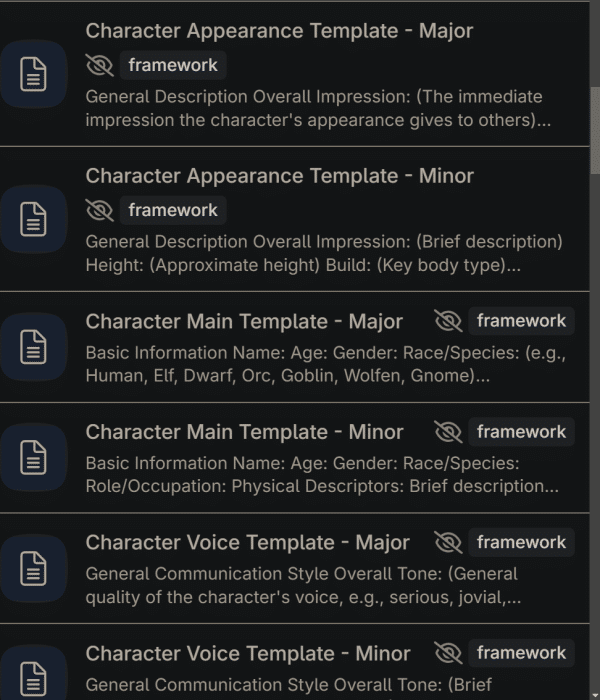
With these 6 templates added to the frameworks, I'll get the Dev Editor to help build several more. A framework isn't necessary for every worldbuilding element I might want to add to the Codex. For example the setting has really only one magic system and it's detailed in several codex entries that are more like quick essays.
When I Build a Framework (or Not)
- A framework is quite useful when I plan to invent and describe a variety of things that all fit in a category, such as characters, factions, settlements (camps, cities, towns, etc.). It helps to keep the LLM's understanding of those items consistent in the story, until I want it to change, and it can help keep consistency from one LLM to another, if I'm using several different ones at different points in the story. It also helps ensure I don't accidentally leave out a detail about one character.
- Frameworks are also handy to create sets of rules or guidelines. For example, I made frameworks to help describe how each culture and species names things like people and places, and how they tend to speak.
- A framework is also useful if I need to explain something to an LLM, once or many times, but I'm not certain what the LLM needs for input or how to instruct and organize it.
Depending on the LLM, it's often possible to skip frameworks entirely, but I like the order it imposes, especially for longer works.
On that note, this is a situation where it really pays to select and mix which LLMs you use for developing the frameworks and then for using the frameworks. I find GPT4o to be logical and capable enough to design a thorough framework without becoming distracted, but for anything close to prose, the GPT models are not the best. There are plenty of models that do a better job with more natural prose, but Claude 3: Sonnet is one I like to give the task of using the frameworks to generate creative Codex entries. The GPT4o-built framework really resembles scaffolding and some dry instructions, but Sonnet is able to follow those instructions and use the frameworks to produce Codex entries that are quite pleasant to read.
In the next part of this series, I'll share another set of frameworks and show how I developed them with the help of the Dev Editor prompt and GPT4o. Then I'll show how I used them and maybe some example outputs I'm using in my novel.